There’s something (humble?) about Mary
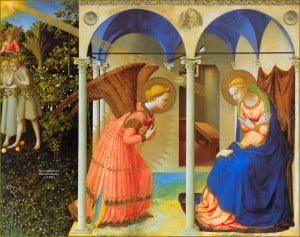 This week we celebrated the Annunciation, the announcement by Gabriel to Mary that she will become pregnant and give nascency to Jesus recorded in Luke 1—and it reminds us that Christmas is coming! I know Christmas circular messages are not everyone's cup of tea, but nosotros enjoy writing ours as a review of the year, and catching upwardly with what has been going on in the lives of others. For those who don't similar them, their distaste is summed upwardly in that archetypal circular where everything is goingwonderfully well—the demands of new jobs following promotions, the stresses of getting ready for exotic strange holidays, and the difficulty of keeping upwards withand thenmany achievements by the children. (Should yous receive any like this, Lynne Truss offers a variety of ways of responding..)
Such paragons of perfection don't do much to cheer us up, considering they look far beyond our frustrating, dull and mediocre lives. And my feeling is that, for most of us, that is how Mary makes usa feel also. There are two main theological traditions which fix Mary on a pedestal in different means. The first (in which I was raised) has Mary every bit such a paragon of perfection that not only is she herself sinless, she too was conceived miraculously (which is what the doctrine of the Immaculate Formulation is all virtually) and was herself also assumed actual into heaven.
But there is a Protestant version too, and I was treated to it once when on a chore interview to be a curate in the sermon by the vicar. God used Mary to great outcome, and we want God to utilise us. So what tin we learn from Mary in order to be used like her? She was humble, and then we ought to be humble. She was expectant, and then we ought to be expectant. She was willing for God to use her, then we ought to be willing. She praised God for what he had done, and so nosotros ought to praise God. I am not sure what this sermon was supposed to exercise for my heart, but at that place seemed to be a lot of hardening of the oughteries—I ought to do this, I ought to do that!
Both of these approaches fail to exist true to the account we have in Luke 1 of Gabriel's announcement to Mary and her response. The first turns her into a polished, plaster saint we can put on a pedestal to admire only inappreciably to imitate. The 2d turns the text inside out and makes it say the opposite of what it is actually proclaiming. The main lesson from Luke 1 on how to be used by God appears to exist 'You lot have to make a terrifying angel appear to you'—and I have not yet found out how to practice that. (Answers on a postcard…)
Our starting time clue in understanding the Declaration is to discover Luke's interest in questions of ability. He begins each of his early sections with reference to those in political ability:
In the time of Herod king of Judea in that location was a priest named Zechariah…' (Luke 1.5)
In those days Caesar Augustus issued a decree…(Luke ii.1)
This not but locates his story within the big stories of the time, it also offers a hit contrast between the manner homo kingdoms operate and the coming of the kingdom of God comes amongst his people. Where Matthew talks of 'what is conceived in her is of the Holy Spirit' (Matt ane.xx), for Luke the Spirit comes with 'power from on high' (Luke 1.35). Fifty-fifty Gabriel's proper noun speak of power; his name means 'El isgbr—potent, a mighty warrior, one who will prevail'. He is i of the vii mighty archangels who stand in the presence of God, perhaps referred to in Rev 8.ii. This is no dainty cherub or winged androgyny, only a terrifying vision of spiritual ability and authority. No wonder his first words were 'Exist not afraid'!
Fifty-fifty inside the shape of the story in Luke 1 we can run into a progression, and it is from the qualified to the unqualified. As a priest entering the Holy of Holies, Zechariah might have expected some sort of encounter with God, non least considering he and Elizabeth are 'righteous and blameless' (Luke 1.6). And Elizabeth has that biblical 'qualification' of beingness barren, and then we might expect God to exist at work as he has earlier, with Sarah and Hannah. Yet when we come to Mary, no such qualifications are mentioned, and no explanation of her option is given. She is chosen simply because she is chosen.
It is an idea we struggle with—then much and so that we turn her lack of qualification inside out. We read her exclamation 'he has looked with favour on the low status of his bondservant' (Luke i.48) equally proclaiming her humility is aqualification for God to use her. Merely in the context of a condition-censor honor culture, it really emphasises herlack ofqualification for anything. It's no wonder we struggle with this thought, equally we are so immersed in our 'merit' civilisation. We alive in a world where those who can, win, and those who tin't become knocked out in round 1 (or circular 4 if they fail in a sufficiently entertaining way). We live in a world where those already at the top define who qualifies, so that those who already accept get more, and those who have nothing have even what they do possess taken from them. Mary's praise tells us this world is turned upside downwards because of God's choice.
Indeed, the content of what she exclaims reflects what she has experienced, and it is marked by three things.
 1. It is rooted in Scripture.
Information technology is no accident that Mary's song of praise echoes Hannah'southward vocal of praise when God gives her the gift of her son Samuel (whose name means 'God hears', 1 Sam 2.1–10). In fact it is hard to detect a phrase in the Magnificat which does not echo a poesy somewhere in the OT. God'south sovereign choice of the small and insignificant in the NT is not a contradiction of his action in the OT, just confirmation and consummation of information technology. What Mary experiences hither is what God's people have ever experienced—equally you can meet past the parallelism of her reflections in the get-go one-half of the hymn with the recounting of Israel's experience in the second half.
The NT does non proclaim grace where the OT proclaimed constabulary, since God's calling his people into salubrious patterns of living was ever his gracious gift. No, rather we see the same problem in the OT as we have continued to experience equally God's people—thinking that God'due south selection and call on our lives somehow makes us improve and more than deserving than those around us. Perhaps that's why we have a problem inviting people to services and events at Christmas, as if it was their annual take a chance to tick the 'merit' box past doing their religious bit, or that we are asking them to pull their religious socks up. In fact, an invitation to celebrate Christmas is an invitation to encounter God's free grace.
2. It is focussed on God.
When you wait at the poetic presentation of the Magnificat in most English translation, something is very hit virtually the layout, particularly in the second one-half. 'He has, he has, he has…' It is all focussed on what God has done, not on what we deserve or what we might attain.
Peter Wilby, the atheist newspaper editor, put it very well:
Nothing draws me more than to organized religion than Christmas. That is not considering I lose my atheist religion just because I intensely dislike all the commercial baggage and babble that surrounds the festival. And then, in a spirit of protest, I shall try to attend at least ane carol service and peradventure a midnight Mass, too, also as listening at 3pm sharp on Christmas Eve to the Radio 4 broadcast of the Festival of Nine Lessons and Carols from King's Higher, Cambridge.
All religions have stories at their heart. Christianity, to my listen, has the best: an almighty God who chooses to be incarnated as a human, born in the most humble circumstances imaginable. Whether or non we are believers, we should all celebrate that story in the coming days and ponder its significant.
three. It elicits response
Mary does model the right response—and therefore we should imitate her—just notice the order in which things happen. God acts; the angel appears; Mary responds.
It is frequently said that God's beloved is unconditional, but I am less and less convinced that it is truthful. Put that style, information technology suggests that God loves us and God'southward love has its effect, does its work, regardless of any action on our function. Merely the story of Mary shows that is non true. Yeah, God'southward dearest is indeed unconditioned—there are no preconditions that we need to fulfil commencement. Simply at that place are conditions in letting God's love practise its work in our lives—that nosotros receive it and respond to information technology. As with any Christmas gift, we need to agree out our hands, receive the gift, and unwrap it.
Perchance we should indeed feel nervous about inviting people to Christmas services, and we ought to feel nervous near coming. Because one time we hear this story and are challenged to respond to it, we cannot remain unchanged.
This piece was start published in Dec 2022 based on a sermon during the Christmas season.
If y'all enjoyed this, do share it on social media, mayhap using the buttons on the left. Follow me on Twitter @psephizo.Like my folio on Facebook.
Much of my piece of work is done on a freelance ground. If you have valued this post, would you consideraltruistic £1.twenty a month to support the production of this blog?
If yous enjoyed this, practice share it on social media (Facebook or Twitter) using the buttons on the left. Follow me on Twitter @psephizo. Like my folio on Facebook.
Much of my piece of work is done on a freelance basis. If yous have valued this post, you lot tin brand a single or repeat donation through PayPal:
Comments policy: Good comments that appoint with the content of the post, and share in respectful debate, tin add existent value. Seek first to understand, and then to be understood. Brand the about charitable construal of the views of others and seek to learn from their perspectives. Don't view debate equally a disharmonize to win; address the argument rather than tackling the person.
Source: https://www.psephizo.com/biblical-studies/theres-something-humble-about-mary-2/
 about Mary)
Publicar un comentario for "There’s something (humble?) about Mary"